Blog Description:

This blog is meant to document my experiences as a Fulbright English Teaching Assistant in Germany. I hope my writing will help people who are considering applying for a Fulbright, who want to learn more about daily life in Germany, who want to follow my journey, or anyone else who is interested! Disclaimer: This is not an official Fulbright Program site. The views expressed on this site are entirely mine and do not represent the views of the Fulbright Program, the U.S. Department of State or any of its partner organizations.
Showing posts with label language. Show all posts

Monday, July 10, 2023

Creative Writing Club

Creative Writing Club

             Haikus, nonfiction, poems, romance, letters, any genre–these young writers can do it all!

On Tuesday, March 14th, a group of talented students gathered for the first meeting of Christian-Ernst-Gymnasium’s new English Creative Writing Club. Led by me, this club gathered weekly to learn how to write creatively in English, explore new writing techniques, reflect on themselves and their experiences, and simply make new friends and have casual conversations in English. This group gave students the opportunity to write without fear of being graded, criticized, or judged. 

Each meeting began with five minutes of free writing on any subject in any format. During this time, the students could write whatever they desired without any requirement of sharing it. This weekly ritual helped them relax and enter the right headspace, or the “writing zone.” Then for the next ten minutes, they engaged in a discussion, writing exercise, or game. Next, the weekly topic was introduced, such as nonfiction writing, dialogue, writing body language, poetry, haikus, and romance. The remainder of the meeting was spent learning and practicing it. No matter what theme was presented to them, these students overcame every challenge and adopted new styles with ease. By the club’s final meeting, they even created a collaborative book featuring a piece of writing from each member.

I feel so lucky to be at a school that values the arts so highly and that has enough trust in me to start and lead a club alone during my very first year. These students repeatedly amazed me with their creativity, intelligence, confidence, and communication skills. Hearing their thoughts inspired me as a teacher and a fellow writer. Whether through the written or spoken word, their eloquence, thoughtfulness, and growth throughout the semester are all clear. What particularly impressed me was the fact that there was no attendance requirement, no extra credit, no outside incentive, yet they still came. I am so proud of them and everything they have accomplished. I hope we can continue this extraordinary club when I return to Germany in the fall!

Friday, April 21, 2023

Learning to Appreciate Languages

    For the majority of my life, I despised learning languages. I was convinced that some people are naturally gifted at languages and that I was simply not one of those people. So, how did I change from someone who loathed every second spent in a German classroom to living abroad and speaking it every day?
I didn’t have the chance to start learning a foreign language until seventh grade. Compared to my current students, who start English in first grade, this is quite late. According to what I've learned, language acquisition is easier the younger you start. Starting to learn a new language during adulthood, while it is incredibly beneficial for brain health, is tougher and takes longer to reach fluency.
Spanish felt completely unique to my brain and exercised it in new, unfamiliar ways. I did not grasp it as easily as other subjects; therefore, being the fickle student I was, I assumed there must be something wrong with either Spanish or myself. Most other subjects were relatively simple, so why couldn’t Spanish just click into place like everything else in school?
Over the next few years, I grew resistant to language learning entirely. Frankly, I felt embarrassed by my poor retention and slow progress. When I reached the end of my required time in Spanish, I wished it farewell and good riddance. Most knowledge was purged from my brain and, unfortunately, my memory of even basic words and sentences is severely lacking today. 
Going into college, I knew my degree required at least two years of foreign language courses. At this point, I still hated Spanish and assumed any language would be a miserable struggle, so I decided to enroll in the furthest thing from a romance language I could find. Combined with my own ancestry and my interest in European politics and history, I landed on German.
For the first year, I was afraid to speak up or try at all because any errors were penalized. Many of my classmates took German in high school, so I immediately felt disheartened and behind. Since I never needed German in daily life, I questioned its usefulness and my motivation waned.
The turning point for me came in the form of an energetic, understanding Bavarian woman named Frau Steigerwald. In her classes, she showed a level of empathy and patience unparalleled by any of my previous language instructors. She showed me that language is more than just a grade or something you get right or wrong: language is a wonderful tool, a way to make connections and learn, a window to more of the world and its people. She opened my eyes and completely revolutionized my attitude about German. Her positive influence is why I chose Bavaria as my top preference for my Fulbright placement.
In my experience, I’ve also discovered that extracurricular opportunities are just as valuable and informative as, if not more than, experiences within the traditional classroom setting. I realized I spoke German much more freely while attending local Stammtisch events and connecting with people casually than in my formal courses. Communicating without fear of a bad grade or red marks through every error healed my relationship with languages.
Because I am still a language learner myself, I will never forget the position my students are in or how daunting a foreign language can be. Empathy is the most vital trait a teacher can have and I learned the value of it from Frau Steigerwald. She understood that I struggled with the language, despite trying my best, so she let me make mistakes and experiment, finding creative ways to communicate using the words I knew. Once I felt comfortable enough to try, fail, and try again, I found that not only am I decent at German, but I actually, dare I say, enjoy it! Now, I am trying to show my students that it’s okay to make mistakes—I make them every day in German—and create a space where they feel comfortable experimenting, failing, and trying again. 
If you are learning a language, don't give up! Stick with it, I promise it gets easier. 

Monday, March 13, 2023

The Schneiders Take Europe


Family in Prague

    My family came to visit me!! The days I spent with them exploring Europe and sharing snippets of my new life here were the best I’ve had yet. Here’s a brief summary of our adventures:


    The weekend before they arrived, I visited Switzerland for the first time with some of my Fulbright friends. Our first day, Friday, February 17th, we explored the city, baked cookies, played board games and were very merry.


Julia in Zürich, Switzerland

Lake Zürich


    The next day, we took a ski lift to the summit of Kronberg, a mountain in the Swiss Alps, and hiked down from the top. The views were beyond compare. There were several moments during our descent where I was so stunned that I had to simply stop and stand in awe of my surroundings. It is the most beautiful place I’ve ever visited.


Happy Julia with the Swiss Alps

Fulbright Friends Hike in Zürich

Zürich Fries in the Alps


    The fries were good, but nothing beats the view.


Zürich Dog Friend


    Made a new friend in Jakobsbad. 


    The group wrapped up our weekend in Switzerland with a trip to Lindt’s headquarters on Sunday. We toured the factory and filled our stomachs with free samples.


Lindt Chocolate Zürich


    The morning of Monday, February 20th, my family arrived in Munich! As quickly as I could, I rode a train down and met them in the airport. The moment when I spotted them, ran to them, and finally embraced them for the first time since Christmas break is a memory I’ll treasure forever. We then took a tram to our quaint AirBnb, spoke with the kind old German woman who was our host, and toasted our reunion with German beer.


Reunion in Munich

    After a collective nap, we enjoyed some Bavarian food at the aptly-named Schneider Bräuhaus. To end the evening, we explored the area around Marienplatz and stumbled upon a band playing to celebrate Karneval. The jubilance of the crowd and players was contagious, immediately lifting our spirits.  


Schneiders at Schneider Brauhaus

Marienplatz

    The next day, we visited the Dachau concentration camp. Everyone should be informed about the Holocaust and for me, I've long considered it vital to visit a memorial site in person. After visiting it twice within three months, I can soundly say that I need to take a brief emotional break before visiting another concentration camp again. That night, we spent time around the city center and ate some typical German street food: meat and bread.


Meat and Bread on Stick

    Our next stop was Salzburg, Austria! Though we only spent a few hours there before continuing on to Vienna, I loved walking through the city, especially the Mirabell Palace and the surrounding gardens, which may be recognisable to fans of "The Sound of Music". We also visited the Mozart Wohnhaus, a museum dedicated to Mozart and his family.


Julia in Salzburg

Mozart Wohnahus

    Vienna is an incredible city. Even though we spent hours on a bus tour and walking through the city, I felt like I barely dipped my toes into what Vienna had to offer. My favourite part was the House of Music, which included many interactive exhibits, lengthy biographies of numerous historic composers, and gorgeous music. There was even a theatre within the museum playing a full orchestral concert. The music was so wonderful that Mom and I were tempted to stay there and listen for hours and hours.


Conducting

Conducting2

    Conducting like a mad genius or engaged in a wizard duel?


Freud Museum

    Sigmund Freud museum


    Next stop: the Czech Republic! Out of all the places I’ve visited so far these past 6 months, Prague felt the most distinct. Unlike Germany, Switzerland, and Austria, I cannot speak or understand a lick of the Czech language, which made navigating and ordering food challenging. Overall, I enjoyed the architecture, the candy shops, the messy Trdelnik, and so much more!


Family in Prague

Turkey Memorial


    Memorial to the victims of the earthquakes in Turkey.


Prague Astronomical Clock


    Prague's astronomical clock. Created in 1410, but incredibly technologically advanced.

Prague Castle

    We hiked up to the Prague castle, which gave us a magnificent view of the city.


Julia Prague

Mom and Julia Prague

Church

Dan, Dad, Me in Prague


    On Monday, February 27, my week of vacation was over and I returned to work. My family stayed in an AirBnb close to my Studentenwohnheim (student apartment) and explored on their own until I got off work and joined them. For lunch, we ate with my friends Lea and Laura, then we met up with a wonderful colleague of mine and hiked up to the Walberla peak in the Franconian mountains. Afterwards, we enjoyed some Schnitzel at a local Gasthaus. 


Walberla: Frankische Schweiz


View

Gasthaus


    Tuesday after work, my partner teacher invited us over for a Raclette dinner with her family. I’m hoping that my family enjoyed it so much that there’ll be a Raclette grill back home when I return in the summer!


    Wednesday, March 1st was my final day with my family. We had lunch at my beloved cat café, then spent the day in Nürnberg. Saying good-bye to them was extremely tough, but I feel so lucky to have shared this time with them.


Ken in Nürnberg

    In all places except Prague, I served as my family's primary navigator and translator. I impressed myself with how well I adapted to each location, despite still being relatively new to Europe myself, and it reminded me how much progress I've made in just 6 months. I think I handled my role well and I even helped teach my family a little German!


    Overall, I wish we had a bit more time at each of the cities we visited. We had just enough time to get a small taste of each city, but not enough to fully indulge and settle in. 


    My favorite part was just spending time with my family. There’s nothing better than being in the place I love with the people I love. I am so thankful that they came to visit me and I can’t wait to see them again. 


So long, farewell, auf Wiedersehen, good bye…

Saturday, January 28, 2023

Student Spotlight

    My students here in Germany have repeatedly impressed me with their willingness to learn, their enthusiasm, their intelligence, and their ability to quickly absorb and remember English. I am so proud of the progress they are making. Working with them makes me incredibly happy and I’m extremely thankful that I get to teach them every day. Here are some of the highlights so far:

Students learn English numbers by drawing monsters


Travel Brochures

I’ve discovered that most of my students, especially the younger ones, LOVE artistic activities. By integrating creative activities into my English classes, I can vary the structure of each lesson, intermixing content-heavy lecture periods with a simple song they can sing and dance along to, a couple games that will get them up and moving, or a relaxing coloring activity to calm down. With art, I’ve also found the students don’t become bored, they stay engaged with the topic until the very end of the hour, and they continue to engage with each other and me in English, like proudly presenting their art and declaring, “I’m finished!” Of course, the art they create is always directly related to the topic of our lesson. The monster pictures, for example, helped the students learn English numbers because the students were given a specific number of eyes, arms, legs, horns, and teeth they had to include in their drawings. For the travel brochures, the vast majority of the work was the writing, but the drawing portions helped disguise it and kept them much more energized than if they simply had to write a paragraph about their given destination.


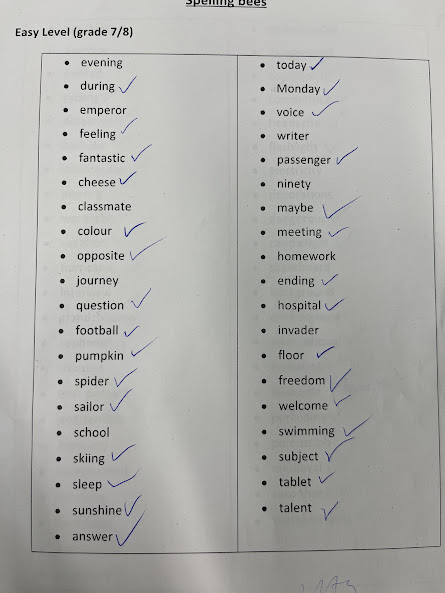
Spelling Bee Word List


This week, some of my students participated in their first Spelling Bee! None of the teachers or students I talked to had heard of a Spelling Bee before I presented the idea to them. Even with the pronunciation differences between German letters and English letters–which are particularly tricky for vowels–they persevered through tougher and tougher words and thoroughly impressed both me and themselves.


Super Simple Songs: The Skeleton Dance


For my elementary students, I often include at least one simple English song per class to get them moving and engaged, such as “If You’re Happy and You Know It”. In the days leading up to Halloween, I used the song “The Skeleton Dance” to help teach the students about parts of the body (“The foot bone’s connected to the leg bone”). After introducing them to the English words for parts of the body, we listened to the song once to identify the vocab, then we all danced along to connect the movements to the lyrics. They LOVED IT. Each class that danced along pleaded, “Nochmal!” (Again!). From the way everyone participated, I could tell it was one of their favorite lessons.

I love any gifts the students give me, especially drawings. The final lesson before Christmas break, one student even gave me a small box of chocolates!


At least once per lesson, I give the students a chance to answer questions and discuss the topic with a partner or a small group. Unfortunately, it’s impossible for me to hear from every single student in the span of one hour, so these discussions ensure everyone in the room speaks English at least once per lesson. For those who are quiet or insecure about their English, I’ve discovered they are more open to speaking English with a peer than when the whole class is listening, which I completely understand.


My oldest students have repeatedly impressed me with their thoughtfulness, their knowledge of US affairs (I’d estimate much better than the average American high schooler’s knowledge of German affairs), and so much more. They’ve asked me how specific American policies have affected me personally, they’ve told me about their own ambitions of going to the States or attending Harvard Law, and they’ve even taught me new information about Germany. Frankly, many of my oldest students are more skilled with English than I am with German. With them, I try to allot at least one-third of class to student talking time. The answers one student provides often provokes another to respond with an opposing perspective, and the question I posed quickly becomes an organic class-wide controlled discussion, which I’ve found can be more beneficial than just listening to me present the information.


In my position, I’m lucky to have the time and freedom to create unique, engaging, fun lessons that get the students excited to learn English. Their energy and intelligence brings me so much joy each time I’m in the classroom. Their desire to learn is so infectious that it strengthens my desire to teach tenfold. They inspire me to be a better teacher and to continue improving my German.


Wednesday, December 7, 2022

Learning German Through Yoga

Julia Rose doing yoga with a German-English dictionary


    I have now lived in Germany for three months. During that time, my German has massively improved, but I am still nowhere near fluency. While I agree with the notion that immersion is the best way to learn a language, immersion is not enough on its own. Practicing on your own time, like playing Duolingo or listening to Disney songs in German, is necessary as well. Unfortunately, language learning has always been challenging for me, and despite my best attempts, I am still stuck in B1 (intermediate). 

    I’ve found that attending yoga classes has been a surprisingly effective way to learn German. During class, the instructor speaks slowly and enunciates clearly, giving me enough time to fully process and understand what they said. Because the instructor is usually the only one speaking, I can listen without feeling stressed about formulating the correct response. In addition, since I’m already familiar with most yoga sequences and poses, the instructions are easy to follow and an excellent way to learn new vocabulary, especially words relating to the body. Yoga is also a nice way to meet new people and chat with them before class begins, but without the expectation of holding a lengthy conversation. Finally, if I don’t understand something, I can simply look to the other participants and match their movements. It’s a relaxing environment where I don’t worry about being “found out” as a foreigner.

    To those who want to improve their language skills, I recommend taking a yoga class!

Tuesday, October 11, 2022

Foreign-Born

   
Julia Rose at the Capitol Building in Washington DC


    While this past month has been overwhelmingly positive, being a foreigner in Germany can be exhausting. Before I leave my apartment each day, I mentally prepare myself to communicate in my non-native language and sometimes practice phrases I might need. I always order food and buy groceries in German, but sometimes, if people realize I'm not a native speaker, they will switch to English and won't switch back, even if I continue to ask questions and respond in (imperfect) German. On the other hand, when someone says something I don't understand, especially if it's a question that requires a quick response, I feel embarrassed and incompetent. It takes significant mental energy to operate in a language besides your mother tongue, so I feel guilty for not being more proficient when speaking with colleagues or my German friends. If it's tiring for me to speak German, it must be tiring for them to speak English with me, so I either criticize myself for not being closer to fluent or I don't speak if I can't find a way to express my thoughts in German.

    On Monday October 3rd, I was sitting in the laundry room with my earbuds in, zoned out and minding my own business. Suddenly, I felt a tap on my shoulder and met eyes with a woman around my age rapidly speaking German. After mentally returning to this reality, I quickly understood she was having a problem with her dryer, so I followed her to it, still a bit discombobulated. I realized that the start button was so bent inwards from overuse that it wouldn't work, no matter how hard she pressed it. She also explained that she had already paid for this dryer and the other one was broken, so she couldn't move her clothes. My head felt frazzled, so I listened, nodded, and understood, but didn't respond. Finally, she pushed hard enough on the button that it managed to start, and we both breathed a sigh of relief and chuckled. She began to ask me another question that I cannot remember, and when I started to respond, she interrupted me and said, "Oh, you speak English?" "Yeah," I replied. Within the next minute, she had left the laundromat, clothes still tumbling. The shift from her friendly, talkative nature to suddenly cutting me off and leaving seemed abrupt, but the change probably came from her realizing a conversation with a stranger in the laundromat might not be as easy anymore.

    After touring the Würzburg Residenz, I took a stroll around the surrounding gardens. Inside the Residenz, photography was forbidden, so I wanted to capture at least one photo from the outside to remember the experience. I found a spot by a fountain with a nice view of the building, but quickly noticed I seemed to be the only person standing alone. I felt awkward and anxious amongst the large groups, families, and couples, until I finally worked up the courage to politely ask one of the men if he would take my picture. He looked at me and flatly said, "American or English?" A bit stunned, I sheepishly said, "American." He then accepted my phone and took my picture. When I thanked him afterwards, he said nothing. Now when I look at the photo, instead of recalling the art, the beauty, and the wonder I felt during the tour, all I can think about is how my stomach was twisting itself into a knot with shame. Why was that the only thing he said to me? I wish I hadn't asked him, why didn't I approach someone else? Why did it matter that I'm a foreigner? Why does it matter so much?

    If I'm just ordering a pizza, is it necessary for the shopkeeper to ask where I'm from and what I'm doing in Germany? It may be small talk, but it can also be grating. When an integral part of your identity is different from most people around you, and that difference is repeatedly noticed and highlighted, you might feel ostracized. "Where are you from?" begins to sound like "You're not from here," or "Why are you here?" or "You're not supposed to be here," or your fears even exacerbate it into "You don't belong here." I recognize that as a white English-speaker living in a predominantly European area who knows some German and is actively working to improve it, who also has significantly passport privilege and decent financial security, in many ways, I am playing life on easy mode. I have so much empathy for everyone else who experiences this at a much harsher level, and I can only imagine what it's like.

    Maybe the man I approached was just tired. Maybe the girl at the laundromat just had somewhere to go. Maybe nobody ever means any harm, but I do miss when nobody asked.

Friday, September 23, 2022

Teaching

Christian Ernst Gymnasium

    I have officially concluded my first week of working as an English Teaching Assistant! To sum it up in one word, it has been wonderful.

    My fellow teachers have been very welcoming to me, answering any questions I have, introducing me to the students with enthusiasm, and granting me their trust. They’ve complimented my German abilities and my motivation numerous times, which I appreciate. Although most of my conversations have been with those who teach English or who have spent time abroad in an English-speaking country, I have also conversed with staff members predominantly in German. Last Friday, I bonded with many of them as we took a train to a nearby town, hiked 5 kilometers to a Biergarten, ate lunch, hiked the 5 kilometers back, and finally rode the train back to Erlangen together. Although it was extremely mentally taxing to hear and speak so much German for hours on end while engaging in light exercise, I think I made a good first impression. Since then, some of them have watched how I present lessons and handle a classroom, and most seem eager to have me in their classrooms again (my permanent schedule is not 100% set yet).

    Making interpersonal connections and discussing cultural differences have been some of my favorite moments so far in Germany. Just yesterday, I spoke with one of my colleagues about the differences between American teachers and German teachers, both in terms of expectations placed upon them and the treatment they receive. I spoke frankly about the challenges that today’s American educators face, such as criticism from administrators, politicians, and parents, certain states or areas banning books and regulating what teachers can/should teach, and gun violence. The exchange of knowledge, personal experiences, and differing perspectives is, to me, the heart of the Fulbright experience. I find the process of learning extremely fulfilling, and I cannot wait to see how I grow as a person by the end of this year.

    The students have been, of course, the best part of my week. Overall, they strike me as intelligent, inquisitive, good listeners, and well-spoken. In addition, they seem to be remarkably well-behaved. On Tuesday, there was a mistake on the class schedule, so the teacher and I needed to move our class of Year 5 students from the second floor down to the basement. I was extremely impressed when the teacher simply told the students about the mix-up, then they quickly gathered their belongings and began walking. No lines, no arguments in the hallway, no need to monitor them every step of the way. The teacher and I walked at the back of the group, and by the time we reached the correct classroom, most of the students were already seated and pulling out their supplies. 

    I posed two questions to some of my classes: First, why is it important to learn English, or what are your personal motivations for learning English? Second, is it important for native English speakers to learn another language? A surprising number of students answered “No, it is not necessary,” for the second question. With both questions, we discussed English being the lingua franca of the world, how widespread English education is across the world, and the influence of American pop culture, such as music and movies.

    There were a couple times this week when I stumbled over my words or embarrassed myself, but I managed to laugh it off without feeling shame. I hope my students feel comfortable experimenting with English with me and making mistakes because I have already made several mistakes in German, such as saying my favorite German food is Käse Schinken instead of Käse Spätzel; my students managed to correct me when I said, "It's the German version of macaroni and cheese!" I'll use my own struggles as a German learner to inform my decisions as a teacher and I hope my students can relate to my experiences.

    This week, the students reminded me of why I love teaching so much. After I finished my introductory lesson, some of the classes surprised me by clapping for me. It was touching to look around and see such genuine smiles and appreciation from these students. Other students waited after class to speak with me privately or ask me a personal question. Even after only one week, I remember a few names and a few instances where a student and I connected over something (like being Ravenclaws and liking Luna Lovegood!). I still miss my students from last year, and I hope the connections I make this year are as just as deep and fulfilling. I am endlessly grateful for this opportunity, and I can already tell I am going to love my job.

    Even the school’s cafeteria is impressive. When I ate lunch with some of my colleagues, I discovered that the cafeteria has its own personal chef who makes the meals each day. Rather than typical American school lunches of cardboard pizza, bendy carrots, a tasteless fruit cup, and a box of milk, I enjoyed a full serving of fresh, hot ratatouille with some sort of delicious Austrian dessert. 

    Since this school is focused on the arts (music, theatre, and visual arts), many of the walls are decorated with the students’ creations. Walking out of the building earlier, I passed a group of girls playfully singing in harmony with each other. I have also been asked to occasionally attend rehearsals for the school play, which will be in English, and offer my help with pronunciation, phrasing, etc. It is wonderful to be in a place where the arts are not only properly funded, but also openly valued and celebrated.

    Next week, I will add the primary school to my weekly schedule. As of now, I will work at the high school on Monday through Wednesday and at the elementary school on Thursdays. I have Fridays reserved for lesson planning and my university coursework (and a little bit of travel, when I have the chance).


    Accepting this Fulbright award is one of the best decisions I’ve ever made. I am expanding my horizons, growing in independence and knowledge, and living in the moment. Education is a wonderful gift and I hope my students benefit from this year as much as I know I will. 

Wednesday, September 14, 2022

A Baker's Kindness


Baked Goods in Erlangen

    I wrote this in my journal earlier today, but I thought it might do some good here:

September 14, 2022
    Amidst the chaos of everything recently--trying to gather all the correct papers for my residence permit, preparing to be both a teacher and a student, improving my German, attempting to master the bus system, and so much more--it's nice to have small moments of peace and personal happiness. This is one of those moments. After a morning spent completely chained to my desk searching through university classes on my laptop, I am now sitting outside a cute bakery with a large cappuccino and an apple strudel. Both taste like they were made with love and respect for the culinary arts, but it was the lady behind the counter that made my day. As I took my time at the counter silently trying to match the German names I read with the baked goods I saw (okay, Apfelkuchen means apple cake, so it must be that one!), she waited while I took "einen Moment, bitte," (a moment, please) to decide what to order. After I pointed to something and asked what it was, I immediately knew she recognized that I'm a foreigner from the deliberate and slightly slower way she explained the items. However, instead of switching to English, she continued to speak in German, which I deeply appreciated. Although I took longer than a typical customer and needed a little more assistance, she listened and responded without any air of judgement. Now, I get to sit here, despite the rain, despite the cars passing by, and despite the construction right across the street, and feel at ease. 
    When someone gives you patience without patronization, when they understand your differences without making you feel different, and when they give you the chance to learn without making you feel guilty or stupid for not already knowing, then you begin to feel accepted. You feel like you'll belong someday, or maybe that you already belong.

Sunday, September 11, 2022

Die erste Woche

“All of the doors yet to open,
all of the rooms ahead—
they’re beckoning bright,
scary and new,
but I’m standing tall,
and I’m walking through!”

-The Life I Never Led from “Sister Act (The Musical)”

Julia Rose with her parents before getting on her flight to Germany

    This week has been…incredible. Challenging. Wonderful. Exhausting. I could use many adjectives to attempt to describe my experiences thus far, but none can perfectly summarize everything. I will attempt to be concise in this post and not ramble too much!

Die Stadt (the city)
    So far, Erlangen has been a lovely place to call home. Sidewalks are wide and often color-coded--red for cyclists and grey for pedestrians--making it extremely convenient for me to walk anywhere I need to (By the way, the importance of staying in the correct sidewalk section was a lesson I learned on the first day as I was carrying a heavy grocery bag back from Aldi and noticed cyclists kept swerving around me. Oops!). On Tuesday, I went on a walking tour of the city, which gave me the chance to meet other international students living here, marvel at Erlangen's many old buildings, and learn a bit more about the city's history. The activity I've enjoyed the most was walking around the Schlossgarten (castle garden) while sipping some local coffee and conversing in German with one of my new friends. This photo was taken in front of the Schlossgarten's spectacular Huguenot fountain:


Das Studentenwohnheim (the dormitory/student residence)
    I am very happy with my living quarters. With my own private restroom, a small kitchen space, and plenty of storage, it feels more like a small apartment than a dorm room. I am on the top floor, so I have a magnificent view of the surrounding neighborhood. 

Essen (Food) 
    Erlangen offers a wide variety of culinary choices. So far, I have eaten out twice: once at an Indian restaurant and once at a more traditional German restaurant called "Brasserie". I also felt quite accomplished when I ordered and paid for some delicious ice cream completely in German!


Die Menschen in meiner Stadt (The people in my city)
    Erlangen boasts a diverse and (in my experience) friendly population. Even when I mispronounce a word or struggle to format a sentence correctly, the people are patient and nice. Every bus driver has been patient as I try to pronounce the names of stops and streets correctly. When I bought my first Pullover (sweater) in German yesterday, the cashier was kind even when I misheard "neunzehn" (19) as just "neun" (9) and only gave him ten euro before quickly realizing and correcting my mistake. Last night, I learned that German waiters and waitresses do not need as large of a tip as in the United States, so I encountered a bit of confusion when I tried to leave a 5€ tip for a meal that cost a little less than 15€! Our Kellner (waiter) was kind and corrected me, explaining to me that only a euro or two is normal for a meal like mine.
    However, I understand that my experiences are merely my own.  Looking like I do with a name like Julia Schneider, it is incredibly easy for me to blend in. As of yet, I have not encountered any rudeness, impatience, anger, or suspicion from others. I recognize that I have a certain level of privilege and that my observations and experiences are not universal.

Meine Freundinnen (My friends)
    I have made two friends so far in Erlangen! By signing up for the local university's "Buddy Program", I have been introduced to two German women who have helped me tremendously. They helped me carry my luggage to my dorm, they've helped translate for me when I did not understand a specific word or phrase, they accompanied me as I acquired a German phone number, and they helped me establish my own German bank account! We had dinner together last night and engaged in wonderful conversations about politics, cultural differences, languages, and much more. Without their help, along with the assistance and support provided by Sam (son of Dr. Miner, one of my favorite professors) on my first day arriving in Germany, I would not feel as safe and secure as I do now.

Müde (Tired)
    Since arriving, I have found I get exhausted extremely easily. After a full day, I often collapse onto my bed in the evening, unable to even write an email. In the middle of the day at times, my energy feels completely depleted; I’ve had to return to my apartment several times just to take a nap. Adjusting to the time difference (Erlangen is 6 hours ahead of Ohio) is likely a contributing factor, but I believe the major cause is the mental fatigue that results from constantly communicating in a second language. While I am not afraid of making mistakes and I'm not ashamed to carefully consider my words (one of my German friends even told me yesterday that my German has improved just in the week she’s known me), it is mentally taxing to operate in a place where I am not yet fluent in the dominant language. 
    Letting myself rest and relax when necessary has been instrumental in allowing myself to recover my energy and process everything. While part of me is screaming, “Why are you napping? You’re in Germany, get out there and explore while you still can!”, the more logical, reasonable voice in my head knows that I will be here almost a full year, and to burn myself out before I even start teaching would benefit nobody.

Conclusion
    I am proud of myself for how well I am adapting to my new life and its many challenges. I think I am a positive representative for America and I am so excited for the year ahead. Bis später!