Blog Description:

This blog is meant to document my experiences as a Fulbright English Teaching Assistant in Germany. I hope my writing will help people who are considering applying for a Fulbright, who want to learn more about daily life in Germany, who want to follow my journey, or anyone else who is interested! Disclaimer: This is not an official Fulbright Program site. The views expressed on this site are entirely mine and do not represent the views of the Fulbright Program, the U.S. Department of State or any of its partner organizations.

Monday, March 13, 2023

The Schneiders Take Europe


Family in Prague

    My family came to visit me!! The days I spent with them exploring Europe and sharing snippets of my new life here were the best I’ve had yet. Here’s a brief summary of our adventures:


    The weekend before they arrived, I visited Switzerland for the first time with some of my Fulbright friends. Our first day, Friday, February 17th, we explored the city, baked cookies, played board games and were very merry.


Julia in Zürich, Switzerland

Lake Zürich


    The next day, we took a ski lift to the summit of Kronberg, a mountain in the Swiss Alps, and hiked down from the top. The views were beyond compare. There were several moments during our descent where I was so stunned that I had to simply stop and stand in awe of my surroundings. It is the most beautiful place I’ve ever visited.


Happy Julia with the Swiss Alps

Fulbright Friends Hike in Zürich

Zürich Fries in the Alps


    The fries were good, but nothing beats the view.


Zürich Dog Friend


    Made a new friend in Jakobsbad. 


    The group wrapped up our weekend in Switzerland with a trip to Lindt’s headquarters on Sunday. We toured the factory and filled our stomachs with free samples.


Lindt Chocolate Zürich


    The morning of Monday, February 20th, my family arrived in Munich! As quickly as I could, I rode a train down and met them in the airport. The moment when I spotted them, ran to them, and finally embraced them for the first time since Christmas break is a memory I’ll treasure forever. We then took a tram to our quaint AirBnb, spoke with the kind old German woman who was our host, and toasted our reunion with German beer.


Reunion in Munich

    After a collective nap, we enjoyed some Bavarian food at the aptly-named Schneider Bräuhaus. To end the evening, we explored the area around Marienplatz and stumbled upon a band playing to celebrate Karneval. The jubilance of the crowd and players was contagious, immediately lifting our spirits.  


Schneiders at Schneider Brauhaus

Marienplatz

    The next day, we visited the Dachau concentration camp. Everyone should be informed about the Holocaust and for me, I've long considered it vital to visit a memorial site in person. After visiting it twice within three months, I can soundly say that I need to take a brief emotional break before visiting another concentration camp again. That night, we spent time around the city center and ate some typical German street food: meat and bread.


Meat and Bread on Stick

    Our next stop was Salzburg, Austria! Though we only spent a few hours there before continuing on to Vienna, I loved walking through the city, especially the Mirabell Palace and the surrounding gardens, which may be recognisable to fans of "The Sound of Music". We also visited the Mozart Wohnhaus, a museum dedicated to Mozart and his family.


Julia in Salzburg

Mozart Wohnahus

    Vienna is an incredible city. Even though we spent hours on a bus tour and walking through the city, I felt like I barely dipped my toes into what Vienna had to offer. My favourite part was the House of Music, which included many interactive exhibits, lengthy biographies of numerous historic composers, and gorgeous music. There was even a theatre within the museum playing a full orchestral concert. The music was so wonderful that Mom and I were tempted to stay there and listen for hours and hours.


Conducting

Conducting2

    Conducting like a mad genius or engaged in a wizard duel?


Freud Museum

    Sigmund Freud museum


    Next stop: the Czech Republic! Out of all the places I’ve visited so far these past 6 months, Prague felt the most distinct. Unlike Germany, Switzerland, and Austria, I cannot speak or understand a lick of the Czech language, which made navigating and ordering food challenging. Overall, I enjoyed the architecture, the candy shops, the messy Trdelnik, and so much more!


Family in Prague

Turkey Memorial


    Memorial to the victims of the earthquakes in Turkey.


Prague Astronomical Clock


    Prague's astronomical clock. Created in 1410, but incredibly technologically advanced.

Prague Castle

    We hiked up to the Prague castle, which gave us a magnificent view of the city.


Julia Prague

Mom and Julia Prague

Church

Dan, Dad, Me in Prague


    On Monday, February 27, my week of vacation was over and I returned to work. My family stayed in an AirBnb close to my Studentenwohnheim (student apartment) and explored on their own until I got off work and joined them. For lunch, we ate with my friends Lea and Laura, then we met up with a wonderful colleague of mine and hiked up to the Walberla peak in the Franconian mountains. Afterwards, we enjoyed some Schnitzel at a local Gasthaus. 


Walberla: Frankische Schweiz


View

Gasthaus


    Tuesday after work, my partner teacher invited us over for a Raclette dinner with her family. I’m hoping that my family enjoyed it so much that there’ll be a Raclette grill back home when I return in the summer!


    Wednesday, March 1st was my final day with my family. We had lunch at my beloved cat café, then spent the day in Nürnberg. Saying good-bye to them was extremely tough, but I feel so lucky to have shared this time with them.


Ken in Nürnberg

    In all places except Prague, I served as my family's primary navigator and translator. I impressed myself with how well I adapted to each location, despite still being relatively new to Europe myself, and it reminded me how much progress I've made in just 6 months. I think I handled my role well and I even helped teach my family a little German!


    Overall, I wish we had a bit more time at each of the cities we visited. We had just enough time to get a small taste of each city, but not enough to fully indulge and settle in. 


    My favorite part was just spending time with my family. There’s nothing better than being in the place I love with the people I love. I am so thankful that they came to visit me and I can’t wait to see them again. 


So long, farewell, auf Wiedersehen, good bye…

Saturday, January 28, 2023

Student Spotlight

    My students here in Germany have repeatedly impressed me with their willingness to learn, their enthusiasm, their intelligence, and their ability to quickly absorb and remember English. I am so proud of the progress they are making. Working with them makes me incredibly happy and I’m extremely thankful that I get to teach them every day. Here are some of the highlights so far:

Students learn English numbers by drawing monsters


Travel Brochures

I’ve discovered that most of my students, especially the younger ones, LOVE artistic activities. By integrating creative activities into my English classes, I can vary the structure of each lesson, intermixing content-heavy lecture periods with a simple song they can sing and dance along to, a couple games that will get them up and moving, or a relaxing coloring activity to calm down. With art, I’ve also found the students don’t become bored, they stay engaged with the topic until the very end of the hour, and they continue to engage with each other and me in English, like proudly presenting their art and declaring, “I’m finished!” Of course, the art they create is always directly related to the topic of our lesson. The monster pictures, for example, helped the students learn English numbers because the students were given a specific number of eyes, arms, legs, horns, and teeth they had to include in their drawings. For the travel brochures, the vast majority of the work was the writing, but the drawing portions helped disguise it and kept them much more energized than if they simply had to write a paragraph about their given destination.


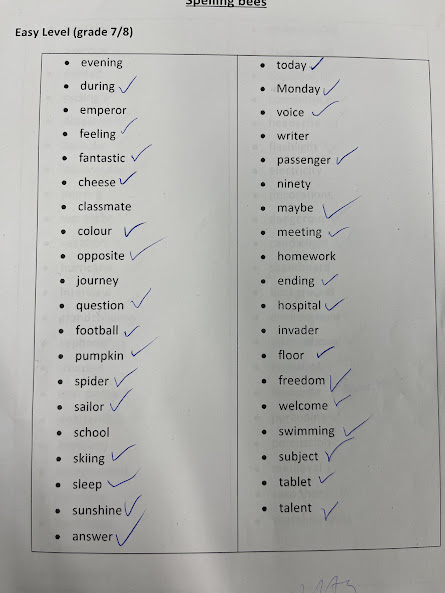
Spelling Bee Word List


This week, some of my students participated in their first Spelling Bee! None of the teachers or students I talked to had heard of a Spelling Bee before I presented the idea to them. Even with the pronunciation differences between German letters and English letters–which are particularly tricky for vowels–they persevered through tougher and tougher words and thoroughly impressed both me and themselves.


Super Simple Songs: The Skeleton Dance


For my elementary students, I often include at least one simple English song per class to get them moving and engaged, such as “If You’re Happy and You Know It”. In the days leading up to Halloween, I used the song “The Skeleton Dance” to help teach the students about parts of the body (“The foot bone’s connected to the leg bone”). After introducing them to the English words for parts of the body, we listened to the song once to identify the vocab, then we all danced along to connect the movements to the lyrics. They LOVED IT. Each class that danced along pleaded, “Nochmal!” (Again!). From the way everyone participated, I could tell it was one of their favorite lessons.

I love any gifts the students give me, especially drawings. The final lesson before Christmas break, one student even gave me a small box of chocolates!


At least once per lesson, I give the students a chance to answer questions and discuss the topic with a partner or a small group. Unfortunately, it’s impossible for me to hear from every single student in the span of one hour, so these discussions ensure everyone in the room speaks English at least once per lesson. For those who are quiet or insecure about their English, I’ve discovered they are more open to speaking English with a peer than when the whole class is listening, which I completely understand.


My oldest students have repeatedly impressed me with their thoughtfulness, their knowledge of US affairs (I’d estimate much better than the average American high schooler’s knowledge of German affairs), and so much more. They’ve asked me how specific American policies have affected me personally, they’ve told me about their own ambitions of going to the States or attending Harvard Law, and they’ve even taught me new information about Germany. Frankly, many of my oldest students are more skilled with English than I am with German. With them, I try to allot at least one-third of class to student talking time. The answers one student provides often provokes another to respond with an opposing perspective, and the question I posed quickly becomes an organic class-wide controlled discussion, which I’ve found can be more beneficial than just listening to me present the information.


In my position, I’m lucky to have the time and freedom to create unique, engaging, fun lessons that get the students excited to learn English. Their energy and intelligence brings me so much joy each time I’m in the classroom. Their desire to learn is so infectious that it strengthens my desire to teach tenfold. They inspire me to be a better teacher and to continue improving my German.


Monday, January 9, 2023

Holidays

American Expat returns home for Christmas

Frohes Neues Jahr! Happy new year!

I am so glad I flew back to the States for the holidays. The time spent with my loved ones was much needed. In addition, my brain got to take a break from German and relax.


Traveling back and forth between countries has shown me that the body and mind are shockingly adaptable. When I flew to the States, life felt strange for the first couple of days, but after that, it felt as though I’d never left. The last four months quickly faded into memory and everything became normal. Now that I’m back in Germany, everything is just as it was before. My hand found the elevator button without looking. My key instantly found the lock in the dark. The circuits of my brain are producing German again, though a bit slower and clumsier than before. The only major difference I’ve noticed is that people have been responding to my German with English more frequently than they did before I left, which makes me think my American accent got thicker over break.


Since returning to Germany, I’ve struggled to fully process my thoughts regarding my time left and my plans for the future. Sometimes, I feel trapped between two worlds, one foot firmly planted in Germany, the other rooted back in the States, leaving me straddled over the Atlantic. If I lose my balance, down into the depths I’ll tumble. The United States is where I lived for the first twenty-two years of my life. Now I’m in Germany, making new connections and creating my own path. While I am happy here, Fulbright is, nevertheless, temporary. I am strongly considering applying for a second year teaching English in Germany and part of me wants to consider longer career opportunities here as well. However, another part of me dearly misses my family, my friends, my partner, my cat, and simply existing in an English-speaking environment. I'm still deciding not just what I might want my future to be, but also where I want it to be. Do I want to consider a future here, away from so many people I love? How much can I settle in when I’ll likely have to uproot everything I’ve built?


Living on my own, an ocean away from those closest to me, is much tougher than I could have anticipated. During college, I was still in the same state and time zone as family and a trip back home was easily possible. Being surrounded by so much love and support during the holidays was wonderful, but it made returning to Germany difficult. It reminded me of what I miss most.


Saturday, December 17, 2022

Dachau

Dachau Concentration Camp Memorial Site

Much as I try, I can’t find the right words to properly convey what I thought and felt when visiting Dachau last weekend. As I walked the same grounds that thousands had before me, I kept thinking about Elie Wiesel, Primo Levi, Anne Frank, and all the other authors whose works have impacted me. I thought about how cold I was in my winter jacket and thick socks, and how cold they must have been. I felt a weight on my shoulders as I walked between the buildings, but above all, a sense of duty and determination: learn, face reality, and use it to make good.

6 million is too devastatingly, abstractly large to fully comprehend. It’s both easier and harder to grasp by thinking about an individual, then a room of individuals, then slowly expanding until it becomes impossible to imagine. I feel it is our duty as human beings to acknowledge and remember the atrocities of the past. As a student of history, as someone living in Germany, as a young person affected by global politics, and simply as a human being, I knew it was necessary for me to visit Dachau as soon as I had the chance.

Once I stepped past the bus stop and onto the actual grounds, I didn’t take any photos. Some people did. I didn’t want to. It’s a memorial, not a zoo.

When I visited, I participated in a guided tour of the grounds. Related to Holocaust survivors, my tour guide was knowledgeable, composed, and empathetic. I am extremely impressed and humbled by anyone who chooses to work at these memorials. It requires a strength that few possess.

A normal city exists by the memorial. While on the bus to the site, I passed neighborhoods, shops, mothers pushing strollers down sidewalks. For some reason, this gave me cognitive dissonance. To me, it felt like a town living in the shadow of history, dwarfed by its past. Yet somehow, life goes on. People move on and people move in. Maybe it isn’t so strange and I’d simply forgotten how close regular citizens were to the actual mass murder. Maybe it’s a bit easier to stomach to think everyday people didn’t know the extent of it, if they were too far away to see the smoke. Unfortunately, that’s not true. As the tour guide said, they knew, but decided they didn’t want to know.

There’s a certain barrier that came down for me now that my German skills have improved. When I wasn’t looking for a translation at the bottom of the screen or an explanatory text, I found the language impacted me more deeply than expected. I hadn’t realized it before, and it’s so simple, but understanding the language of the Holocaust directly as it was hit me like a gut-punch.

No matter how much you study, nothing–no amount of memoirs, classes, documentaries, anything–will compare to walking across the grounds and through the gas chambers where it happened. While the old adage of those who don’t remember or learn from the past are doomed to repeat it, I think it’s possible to know the past and still fail to prevent similar tragedies. As the number of living survivors wanes, it is essential that we all pledge to never forget. 

A special thank you to all the teachers and professors who taught me about the Holocaust. In particular, I want to thank Mrs. Painter and Dr. Mirna Zakic. Night by Elie Wiesel, The Anatomy of Fascism by Robert O. Paxton, and Ordinary Men by Christopher Browning are three of the most important books I’ve ever read. I still remember the hole I felt the day Elie Wiesel died in 2016. I’ll forever carry his story with me.

I want to end with a quote by Anne Frank. Knowing her story, no other words consistently make me as immediately emotional as these:


“It’s difficult in times like these: ideals, dreams and cherished hopes rise within us, only to be crushed by grim reality. It’s a wonder I haven’t abandoned all my ideals, they seem so absurd and impractical. Yet I cling to them because I still believe, in spite of everything, that people are truly good at heart.”

Wednesday, December 7, 2022

Learning German Through Yoga

Julia Rose doing yoga with a German-English dictionary


    I have now lived in Germany for three months. During that time, my German has massively improved, but I am still nowhere near fluency. While I agree with the notion that immersion is the best way to learn a language, immersion is not enough on its own. Practicing on your own time, like playing Duolingo or listening to Disney songs in German, is necessary as well. Unfortunately, language learning has always been challenging for me, and despite my best attempts, I am still stuck in B1 (intermediate). 

    I’ve found that attending yoga classes has been a surprisingly effective way to learn German. During class, the instructor speaks slowly and enunciates clearly, giving me enough time to fully process and understand what they said. Because the instructor is usually the only one speaking, I can listen without feeling stressed about formulating the correct response. In addition, since I’m already familiar with most yoga sequences and poses, the instructions are easy to follow and an excellent way to learn new vocabulary, especially words relating to the body. Yoga is also a nice way to meet new people and chat with them before class begins, but without the expectation of holding a lengthy conversation. Finally, if I don’t understand something, I can simply look to the other participants and match their movements. It’s a relaxing environment where I don’t worry about being “found out” as a foreigner.

    To those who want to improve their language skills, I recommend taking a yoga class!

Tuesday, November 29, 2022

Thanksgiving in Germany

Julia Rose with her German colleagues

    My Papa always said, “No one should be alone on Thanksgiving.” For the first time, I was worried that might happen this year. Thursday was a regular work day and the vast majority of Germans I’ve spoken with don’t regularly celebrate Thanksgiving. Erlangen’s Weihnachtsmarkt is up and running, the Glühwein is flowing, and my students are already excited for Christmas. 

    Thankfully, I have kind colleagues who understand homesickness and wanted to ensure I would have company on Thanksgiving. They knew Thanksgiving is my favorite holiday of the year, so they invited several colleagues and organized a proper gathering.


    Despite being in Germany, having no oven in my Studentenwohnheim, and the struggles I faced trying to find ingredients at the supermarket (I’ve now learned that cornstarch is Speisestärke in German), I was determined to bake a pie for Thanksgiving. Using German ingredients (like Butterkekse instead of vanilla wafers for the crust) and a friend’s oven, I baked one of my favorites: banana cream pie. 


    When I arrived at the host’s house on Thursday evening, I removed my shoes and was offered slippers, or “Hausschuhe”. It felt welcoming to receive and wear them around the house, and supplying Hausschuhe for guests may be a practice I adopt in the future.


    Instead of turkey, we enjoyed Raclette, which is a traditional German New Year’s meal. A Raclette is a type of small grill with removable trays on which one can pile mushrooms, pepper, bacon, onions, raclette cheese (which tastes delicious when melted), and more. I’m proud to say that my banana cream pie tasted as good as it normally does back in the States. With the language oscillating between German and English and enjoying German cuisine on an American holiday, it was an intercultural evening.


    I’m very thankful for my fellow teachers whose company and hospitality made this Thanksgiving memorable. Less than a month until I’m back home to visit my family for Christmas!

Tuesday, November 15, 2022

Privilege

    The longer I am here, the more grateful I am to have been born and raised in the United States. While our country is facing MANY problems, I’m learning more and more how much I lucked out in the birth lottery. Since arriving in Germany, I’ve met people who’ve already endured harsher circumstances than I’ll likely ever experience. I’ve befriended fellow international students who escaped war in their home country, who have family members living in unsafe conditions, and who face discrimination at a level worse than I’ll ever worry about. When you meet and connect with someone one-on-one, the problems they face are no longer something happening on the other side of the world in a distant, obscure country; the issues become something real with direct impacts on the person right in front of you. To my fellow Americans: while our freedoms and privileges are not unique to us, do not take them for granted because they are not guaranteed. Be thankful for what we have and have empathy for those with less.

Friday, November 4, 2022

Living Alone Abroad: Safety Tips and Finding Fun


Julia Rose takes a guided bus tour of Frankfurt

    Moving abroad is tough, especially when you do it alone. There’s culture shock, homesickness, linguistic challenges, annoying bureaucratic processes, loneliness, and more. However, it is also rewarding and serves as an opportunity for personal growth. In less than two months, my German skills have vastly improved. I have the pleasure of teaching English to my students and learning German from my friends and colleagues each week. I live in an affordable apartment with a quaint view of the surrounding neighborhoods. I have health care. I’ve visited new places, tried new foods, and I am constantly adapting more and more to my surroundings.


    The biggest pro to being alone while abroad is that you are the master of your fate, the captain of all decision-making. When traveling, you can spend the whole day visiting museums. You can eat ice cream twice in one afternoon. You can take a break when you need it, eat dinner early, or just feel the afternoon breeze from a comfortable park bench. Nobody can stop you from prioritizing what you enjoy. 


    However, being alone also means there is nobody to share your struggles with. In the moment, there’s nobody to take your picture, nobody to hug, nobody with whom you can share your experiences.


    For anyone who is considering moving abroad on their own, here is some advice on staying safe and finding fun:


    Safety tips for traveling and living alone abroad: 

1. Be smart. If someone or something makes you uneasy, trust your gut. Protect yourself by making good choices.
2. Communicate. If you’re traveling far, tell at least one person about where you are going and your general plans.
3. Conduct research. Familiarize yourself with your base of operations. For areas you visit, research its reputation, areas to avoid, and other safety facts. I should have researched Frankfurt a bit more beforehand and I will be more thorough when I visit Berlin.
4. Guard your belongings. Whether you’re exploring a new museum, taking a public bus, or strolling through a familiar park, be cognisant of the people around you and your purse, bag, luggage, or wherever else you keep your valuables. Whenever possible, do NOT keep your wallet or keys in extremely accessible places like an open coat pocket or the back pockets of your jeans. Instead, opt for hard-to-reach inner pockets, especially ones guarded with clasps and zippers. I haven't experienced pickpocketing myself, but I have heard plenty of stories from friends and acquaintances.
5. Ignore catcalling. It sucks. I know. It’s awful that it happens and that it’s on us to safeguard ourselves against strangers and the repulsive comments they espouse. While you may want to stick up for yourself or another person, the smartest choice is to simply leave the vicinity as quickly as possible.
6. Lie when necessary. If a stranger asks whether you’re traveling alone or where you’re going, it is okay to lie. When a stranger in Frankfurt asked whether I was there alone, I lied and said I was meeting with a friend soon. Nobody is entitled to the intimate details of your life. A little lie can act as a big safety precaution.
7. Make decisions you feel are in your best interest. For example, although I feel safe and comfortable in Erlangen, I rarely ever walk alone at night.
8. Stay aware of your surroundings. There were streets in Frankfurt, especially immediately surrounding the Hauptbahnhof (train station), where I did not feel comfortable (numerous bars, strip clubs, night clubs, and large groups of rambunctious men), so I walked extremely quickly and found alternate routes between the museums and my hotel for the rest of the trip.

    Tips for enjoying your experience:

1. Be confident! 
2. Be yourself. For example, I know I don’t enjoy parties or drinking; I prefer a cozy night in bed and asleep by 11pm. The power of German drinking culture is not strong enough to make me yield. Don’t feel pressured to radically change who you are or what you enjoy while abroad. You know yourself best.
3. Connect with other foreigners. Finding others who can relate to your experiences, especially the struggles, can be validating and comforting. If you’re a college student, your university probably has an International Office that organizes events catered to international students. Check whether your city has a community center and what activities or services it offers. Erlangen’s Volkshochschule, for example, offers language classes in German, English, Spanish, French, and Italian.
4. Engage in your community. Try a yoga class, join a choir, go bowling, or visit a cat café! There are many opportunities to find fun within your community and you might make new friends as well.
5. Exercise manners. Even if your language skills are imperfect, a smile, saying please and thank you (bitte und danke), and a friendly attitude are useful assets for any situation.
6. Get comfortable eating alone. Don’t let the absence of a companion stop you from exploring new restaurants and enjoying the local cuisine.
7. Take time for self-care. No matter where you are in the world, you are a human that requires rest. The world will still be there when you wake up. Continuing to write in my journal and practice yoga have been essential for my mental health and for recovering my energy.
8. Write. Document your experiences in some way, whether it’s on a public forum like FaceBook or someplace private like a journal. For me, writing doesn’t just help me remember what I’ve done; more importantly, it helps me explore and further process my thoughts, emotions, and reactions. Releasing it all onto paper rather than keeping it bottled up inside, especially when you have nobody to confide in, is extremely cathartic.

    These past two months have been scary, intimidating, and nerve-wracking, but more importantly, they've been educational, wonderful, and worthwhile. My final piece of advice for those considering moving abroad: carpe diem. It's worth it.